
Just sent the kid (he’ll be 10 in 2 months) to the shops with his bestie. It’s only about 350m, but they had to cross a busy road.
Henry does it frequently, but it’s a first for Squid! Thank goodness I didn’t hear the sirens until they returned.

Just sent the kid (he’ll be 10 in 2 months) to the shops with his bestie. It’s only about 350m, but they had to cross a busy road.
Henry does it frequently, but it’s a first for Squid! Thank goodness I didn’t hear the sirens until they returned.
We’ve been having (yet more) struggles at school. But he’s happy. He goes to school without complaint, and I’m just relieved that he seems happy.
But he’s slipping academically. Still “on standard” for reading and maths (where he used to be years ahead), but falling behind in writing.
At the end of last term we had a chat to his teacher to try to work on some problem areas – one that was mentioned was figurative language.
Now, he’s been reading since he was four and a half, and I assumed he had a pretty good grasp of figurative language, so this was a surprise to me. Nevertheless, I took every opportunity to discuss figurative language where we found it, and also asked him to do a few “busywork” worksheets at about the right level. I still felt he understood the material without extra instruction.
Fast forward to tonight. We’ve decided to only speak in general terms about the events over the weekend in Charlottesville, only that people are being awful, and that he doesn’t need to know the details. He’s a highly sensitive soul, and sometimes he has nightmares over world events, so we don’t tell him everything, all the time.
I introduced him to the concept of cognitive dissonance, and how some people will continue to believe a comfortable lie, rather than accept a new truth that compromises their world view.
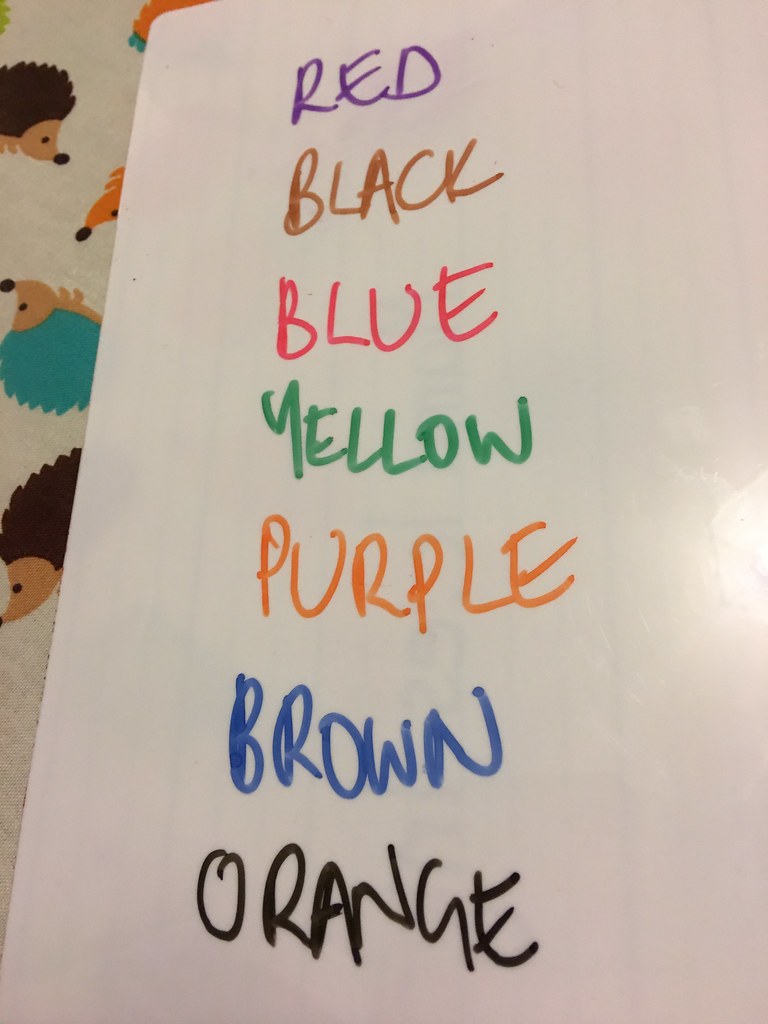
I then asked him to do a stroop test. He did really well, but admitted it was hard.
Then I turned the card upside down, and asked him to repeat the test. I asked if he found it easier the second time, he said, “yes, because the abstraction removes the context, and only shows the content”.
So then I freaked out a little. And then I asked…
“Can you think how that test, and our findings apply to figurative language, and why authors use it?”.
“By abstracting the content, the author can express a message that people might not want to see otherwise”.
Boom.
Just spent an hour swimming with three cuttlefish. Inexpressible joy.
If you’ve ever wondered what it is like to live with ADHD, watch this – a great explanation of why I’m “unreliable”, “lazy”, and “amoral”.
ADHD isn’t a moral failing. I’m going to watch this video on repeat for a while…
Click here for a fabulous picture of a Brain Squirrel!
I had my birthday last week. 47.
A few weeks before that, I had an experience that forced me to confront the fact that my attention issues really were a thing. There was a job vacancy that I thought I would be perfect for, and I wasn’t asked to apply. There may be other reasons too, but the brain squirrels weren’t helping.
That neurotypical people don’t develop post office phobias. That neurotypical people can live their lives without losing something every single day. They can break down a task (like writing an essay, or going to the post office) into logical steps, and then tick them off a mental list as they are achieved. They can complete higher education. They can maintain relationships with people they care about, and if those relationships end, they understand why. They can keep a stable, boring job. They can stay awake through a powerpoint presentation.
That neurotypical people don’t have squirrels in their brains. And the squirrels aren’t on party drugs.
The day after my birthday I forced myself to go to the GP and talk about my symptoms. My mouth opened, and it all came out at once. Before I had barely begun to explain, the GP swivelled on her chair and started to write the referral to a psychiatrist.
A week later almost to the hour, I was in the office of a psychiatrist who has a special interest in adult ADHD. I filled out the screening test paper, and was told that in the spectrum of ADHD symptoms, from mild to “holy shit, I can’t believe you survived to adulthood”, he said that I have been “suffering under a heavy burden of symptoms”.
Here is a pretty clear description of the inattentive subtype of ADHD. This is what I have, not the better known variety with hyperactivity.
Yesterday, I started medication. It’s going to take a while before we will get the correct dosage and medication, and find the right combination of long acting and short acting meds, but I am hopeful that within a few months, life will stop being so hard. And maybe I’ll be able to get to the post office to send you that baby vest I knit when your three year old was a newborn.
Kid just said, “My work looks pretty good on the front, just don’t look at the back”.
Yup. He’s a crafter.
 Disco Knitter